
Union County Projected Versus Actual Release
FDC’s public profile calls the planning field “Current Release Date.” Florida law calls the underlying calculation a “tentative release date.” Both refer to a projected custody-release date for a term-of-years state prisoner. It is calculated from the sentence, lawful credit, and gain time that has been granted, restored, or forfeited. It is not proof that a person walked out of a prison on that date.
An actual release has a completed event behind it. After an FDC release, the released-inmate record may show Release Date and the incarceration history’s Date Out-Custody. A county-jail release record may show the actual date and time, authority or type, and whether another agency received the person. A transfer from Reception and Medical Center to another FDC prison is not a release even though the person leaves that Union County facility.
Scheduled versus actual: Treat a future date as an estimate maintained by the custody agency. Confirm the event with the released-person record after the date passes.
A pretrial detainee usually has no fixed sentence-completion date. Release depends on bond, first appearance, a court order, dismissal, or later disposition. The Union County court file can explain the authority, while UCSO confirms physical processing.
Find a Union County Inmate Release Date
Begin with the system that holds the person. The FDC Offender Information Search covers Florida prison and state supervision populations, including people held at RMC, RMC West, the RMC Work Camp, and Union Correctional Institution. It does not cover a person whose only sentence is in Union County Jail. The sheriff, clerk, and sentencing order are the county route.
- Confirm the facility and operator. Separate Union County Jail from an FDC institution with a similar local place name.
- For a current state prisoner, search FDC by DC number if known. Otherwise match name, birth details, aliases, offense, and facility.
- Open the current inmate detail. Read “Current Release Date” and its warning about gain-time awards, forfeiture, or review. “TO BE SET” means the date is still pending.
- For a Union County Jail sentence, call UCSO at 386-496-2501 and review the sentencing order and jail-credit entries in the Union County case.
- Ask whether a detainer, another sentence, transfer order, or supervision term affects the expected exit.
- Recheck near the date. After it passes, use the released-inmate record and source agency to confirm that release occurred.
When a county-jail record is needed, UCSO Records is at 55 W Main Street, Room 102, Lake Butler, FL 32054. Its verified hours are weekdays from 8:00 a.m. to 5:00 p.m., excluding holidays. A narrow request should name the person, booking or case number, sentence, and date range.
The Union County release-record search path explains how the sheriff record and court disposition work together after a jail exit.
Union County FDC Current Release Date
The live state profile label matters because it is what a searcher will see. FDC displays “Current Release Date” on a current-inmate detail and warns that the value can change pending a gain-time award, gain-time forfeiture, or review. Some records can display “TO BE SET.” That wording should be preserved when asking FDC for clarification.
The official FDC current-inmate example shows the field and caveat.
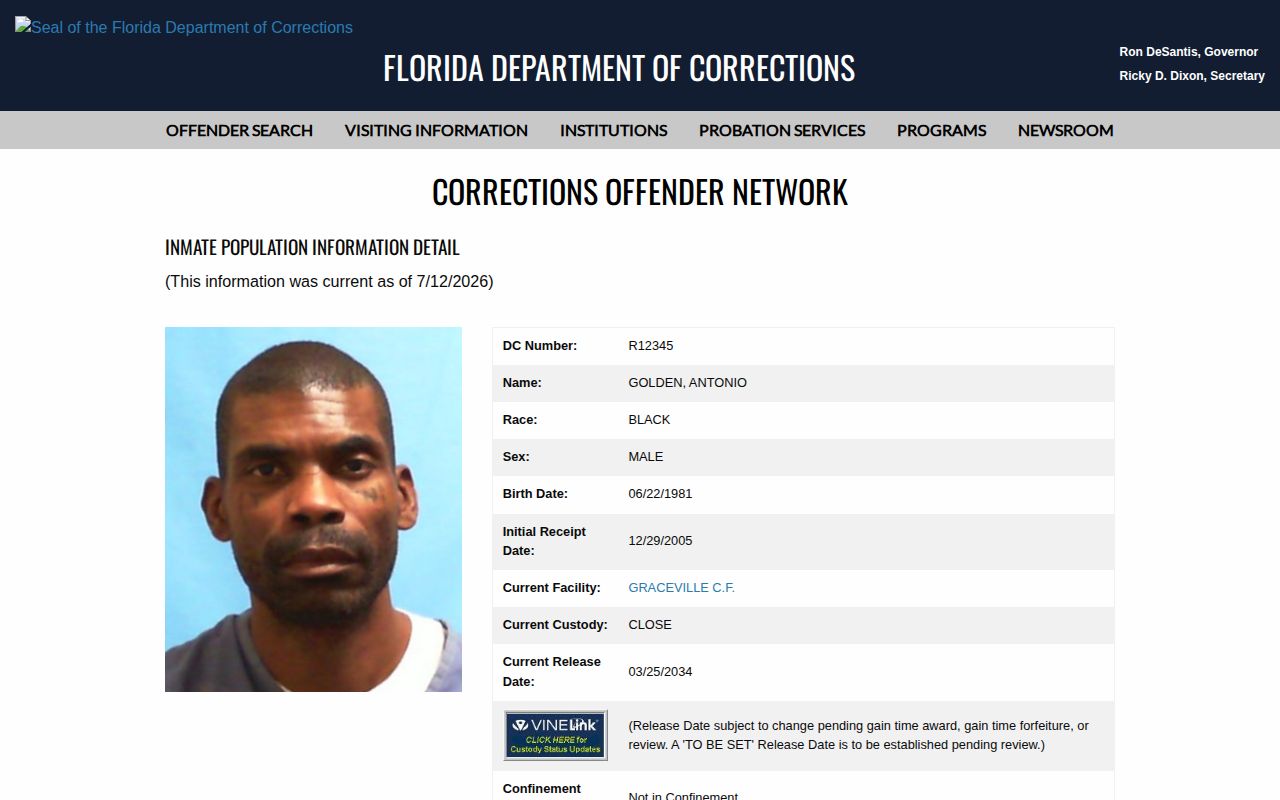
The captured warning is why the displayed date should be recorded with its status and checked again near release.
A current state-prison profile is not a Union County Jail roster. FDC’s own OBIS documentation excludes county-jail and county-probation records. Absence from FDC can be normal for a person who never entered state custody.
Florida Gain Time for Union County
Florida Statutes §944.275 defines the state-prison framework. FDC first establishes a maximum sentence expiration date, reducing the imposed term by lawful credit. It then establishes the tentative release date by applying gain time that has been granted or forfeited. Gain time can move the tentative date earlier. Forfeiture can move it later, but the tentative date cannot exceed maximum expiration.
For covered offenses committed on or after October 1, 1995, FDC may grant up to ten days per month of incentive gain time, subject to the statute’s exclusions and offense-date rules. Under that modern framework, gain time cannot cause release before service of 85 percent of the imposed sentence. Court-awarded credit for physical incarceration counts toward that service floor. Once the tentative date meets the 85-percent date, more gain time cannot move it earlier.
The official gain-time statute shows both the tentative-date definition and the service floor.
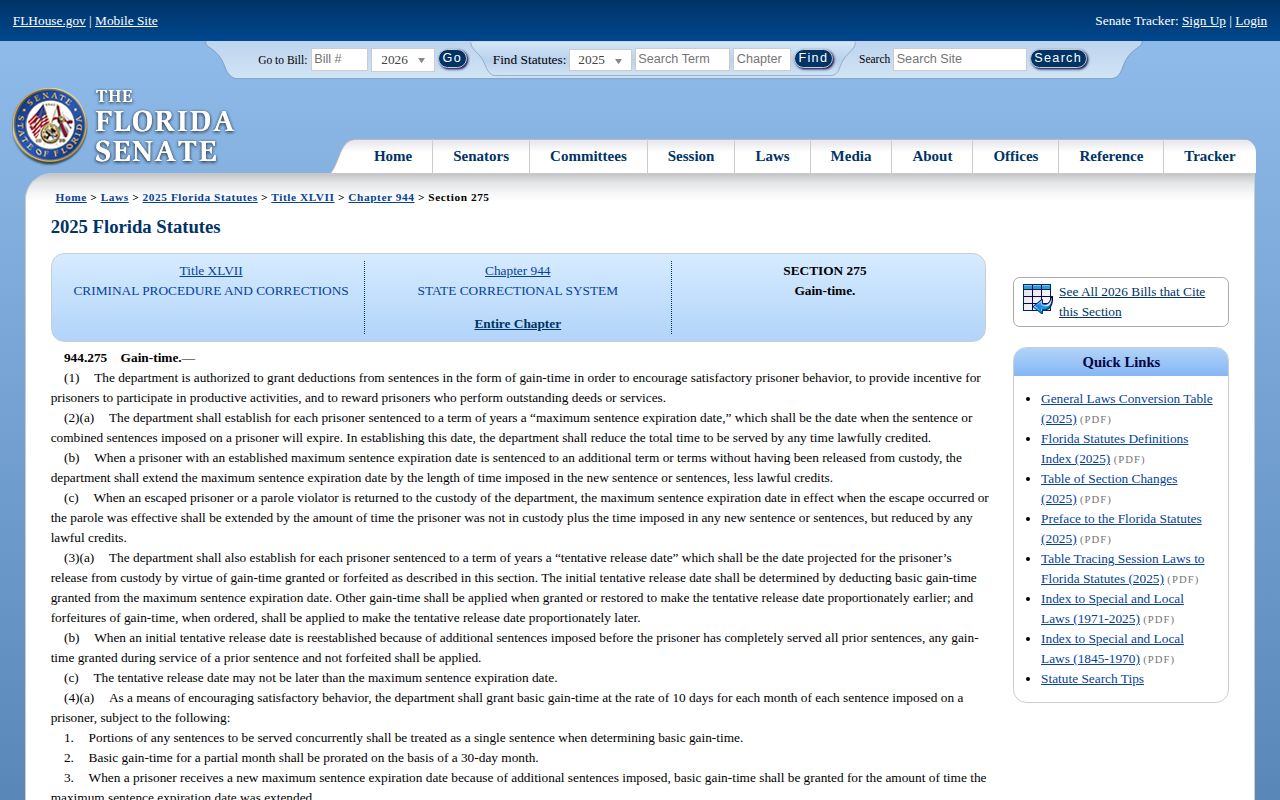
The law does not support a simple universal calculator. Offense date, offense type, mandatory terms, court credit, and agency review still govern the official date.
Union County Jail Good Time
County-jail good time follows a different law. Florida Statutes §951.21 authorizes a county policy for commutation based on good conduct. It describes maximum monthly allowances that vary with years served and allows added meritorious credit on a sheriff or warden recommendation, subject to county action and possible forfeiture.
This county formula is not FDC’s state-prison formula. The 85-percent rule in §944.275 should not be imposed automatically on a Union County Jail sentence. No current Union County good-time policy or UCSO calculation sheet was located in the research. The safe route is to ask UCSO whether a current policy applies, request the maintained computation if public, and compare it with the sentencing order and jail credit.
A request should seek an existing record rather than ask staff to create a new calculation. Chapter 119 generally provides access to nonexempt records, but an agency need not answer a research question or build a new document. This county-versus-FDC distinction is the key local release-date issue.
Note: Never apply a state-prison gain-time estimate to a Union County Jail term without the sheriff’s current policy and court order.
Why Union County Release Dates Change
A projected date is a result of records that can change. Discipline may cause gain-time forfeiture. A corrected credit or restored award can alter the calculation. A court can amend a sentence or add a consecutive term. Another agency can lodge a detainer, which means a request to hold or transfer the person when the current custody ends. FCOR action may affect parole or conditional release for a covered sentence.
| Factor | Possible effect | Record to check |
|---|---|---|
| Gain-time award or restoration | May advance an FDC tentative date within legal limits | FDC current profile and sentence computation |
| Gain-time forfeiture | May move the projected date later | FDC disciplinary and computation record |
| Amended sentence or jail credit | Can change the controlling term | Court order and agency computation |
| Detainer or hold | May cause transfer instead of community release | FDC or jail record and receiving-agency confirmation |
| FCOR action | Can affect eligible parole or conditional-release timing | Commission action or order |
| Pending review | May leave the public field unset or subject to change | FDC profile and Central Records response |
A hold does not always extend the sentence date itself. It can change what happens at the door. The person may leave FDC or UCSO custody and enter another agency’s custody instead of returning to the community.
Union County Release Date Records
A displayed date should be tied to the record that produced it. For FDC, the current population detail provides planning data, while the released-inmate database provides post-event evidence. FDC’s public data also separates active, released, and supervised populations. The released cohort covers state-prison releases since October 1, 1997 and may include identity data, aliases, prison offenses, detainers, and incarceration history. Downloadable OBIS files are updated monthly, so the live individual profile and agency contact can be more useful when timing is close.
Union County Jail uses a different record chain. The sheriff’s maintained booking and release data can identify the physical event. The Union County clerk file can show the sentence, court-awarded custody credit, modification, bond order, or other authority behind it. A court entry does not establish the jail’s exact door-out time, and a jail entry does not replace the judgment. Match the person, case number, booking number, and dates across both.
| Field or record | What it answers |
|---|---|
| FDC Current Release Date | State agency’s current projection, subject to its displayed caveat |
| Maximum sentence expiration | Outside end of the state term after lawful credit |
| Release Date | Completed release date in an FDC released-person record |
| Date Out-Custody | End of a listed FDC incarceration period |
| UCSO release entry | County-jail release time, type or authority, and possible transfer |
| Union County sentence order | Term, jail credit, and court-controlled changes |
Florida records law allows access to nonexempt records under reasonable conditions. Protected information can be redacted, and neither UCSO nor FDC must create a calculation that is not already maintained. Ask for the named record and the public field that needs clarification.
Confirm Union County Release Dates
Before the expected date, save the displayed field and its caveat. Check the court docket for sentence changes and ask the custody agency about public detainer information. A specific-person VINE alert can provide timely notice when the contributing agency reports an event, but transfer, out-to-court, and release are different events.
After the date passes, switch sources. For state custody, use the FDC released-inmate search and look for Release Date and Date Out-Custody in incarceration history. Then check community supervision. For Union County Jail, call UCSO and request the booking or release entry with the exact date and disposition type. The Union County VINELink release check can supplement that source record.
If FDC data is unclear, Central Records questions can be directed to 850-488-9859 with the DC number. Formal public-record requests use FDC’s records portal, with assistance at 850-717-9774. Ask for the existing sentence computation, release or discharge document, and nonexempt detainer information that answers the discrepancy.
Projection helps with planning. The agency’s post-event release record is the proof that custody ended.