
Union County Parole Versus Probation
Florida divides supervision work between two state bodies. Florida Department of Corrections Community Corrections supervises court-ordered probation, community control, and several forms of supervision imposed after state-prison release. The Florida Commission on Offender Review, or FCOR, makes decisions assigned by Chapter 947, including parole and conditional-release matters. An FDC officer may supervise a person whose release terms came from FCOR, but that does not make the sentence "probation."
Probation usually follows a court order and may replace or follow confinement. Parole is discretionary early release for a limited eligible group, largely tied to older or special sentence structures. Conditional release is another distinct form of mandatory post-prison supervision for qualifying prisoners. Read the label in the official record. Calling every supervised release parole can send a Union County inquiry to the wrong office.
| Supervision type | Who sets it | Best verification route |
|---|---|---|
| Probation or community control | Sentencing court | FDC community-supervision result and Union County court file |
| Parole | FCOR for an eligible sentence | FCOR action or order, followed by FDC supervision record |
| Conditional release | FCOR under the applicable statute | FCOR release type and FDC supervision status |
| Sentence discharge | Occurs when the legal term and supervision end | FDC status, discharge record, or court termination entry |
County-jail release and state supervision are also separate events. Someone may leave Union County Jail on bond without any FDC supervision record. Another person may leave Union Correctional Institution under active conditional release. The operator, case, DC number, and displayed supervision type resolve that difference.
- Parole
- Discretionary early release for a person whose sentence is legally eligible, with conditions set through FCOR.
- Probation
- Court-ordered community supervision, sometimes imposed instead of confinement or after a jail term.
- Community control
- A more restrictive form of community supervision ordered by a court.
- Discharge
- The formal end of custody or supervision, not merely movement from one facility.
- Absconder
- A person alleged to have stopped reporting or whose location is unknown to the supervising authority.
Check Union County Post-Release Supervision
The official starting point is the FDC Offender Information Search menu. Choose community supervision when the person is thought to be reporting in the community. Choose all corrections databases when it is unclear whether the record sits in current prison, release, supervision, escape, or wanted data. A DC number is more exact than a name. With a name, compare the middle name, birth information, offense, case, and office details before accepting a match.
- Identify the last custody layer. A Union County Jail release may require the sheriff and court record, while an FDC prison release uses state databases.
- Search the FDC supervised-population route by DC number when possible. Otherwise use the full name and reconcile all available identity fields.
- Read the supervision status and type. Do not infer parole from the mere fact that a person is supervised.
- Note the assigned office and case information. Contact the circuit office if the online record is unclear or appears stale.
- For parole or conditional-release action, check the FCOR calendar and request the commission action or order. An agenda alone shows only that a matter was scheduled.
- Use the Union County court docket when probation was imposed locally. The sentence, modification, or termination order can explain the legal basis.
An active supervision entry supports that the person is in the community under FDC control. It does not supply Union County Jail’s physical release timestamp. For that event, use the Union County released-inmate search and record path and request the sheriff’s source record.
Important: A missing supervision result is not proof that supervision ended. County probation excluded from FDC data, name differences, an update delay, or a different custody system can explain the gap.
Union County Probation Office Route
Union County is in the FDC Gainesville Circuit Office service area with Alachua, Baker, Bradford, Gilchrist, and Levy counties. That circuit listing is the official route for a state supervision question tied to Union County. It should not be assumed that every person reports at the circuit headquarters. FDC’s list also identifies field offices, and an assigned location may depend on the actual case and residence.
FDC Gainesville Circuit Office
14107 US Highway 441, Suite 300Alachua, FL 32615
Phone: 386-853-6207
Fax: 386-462-2534
Email: gainesville.cir@fdc.myflorida.com
The official Gainesville Circuit Office page names Union County in its service list. Give staff the DC number and ask which office holds the case and what public status can be confirmed. FDC Community Corrections central routing is also available at 850-717-3444 and co-supervision@fdc.myflorida.com for a general office question.
Neither line replaces an emergency call or a warrant confirmation. It is a records and routing channel for supervision questions. Exact reporting instructions are between the supervised person and the assigned authority.
Union County Parole Hearing Records
FCOR, not the FDC probation office, handles the commission decisions assigned by Florida law. Its live voting schedule shows recurring voting and teleconference dates, often several in a month. A detailed agenda can list the name, DC number, category, panel or full commission, county, offense, and case number. Categories include initial, subsequent, and effective interviews, presumptive release date clarification, supervision review, conditional-release establishment, final hearings, and revocation matters.
The official calendar is useful, but it is prospective. A name on an agenda proves that FCOR scheduled a matter. It does not prove a release decision or the outcome of a vote. No separate public post-vote results search was found in the current system. To confirm a result, request the commission action or order with the person’s name, DC number, and hearing date through the FCOR public-records channel, then compare it with FDC custody and supervision data.
The current calendar shows how those hearings are organized.
View the official FCOR voting schedule.
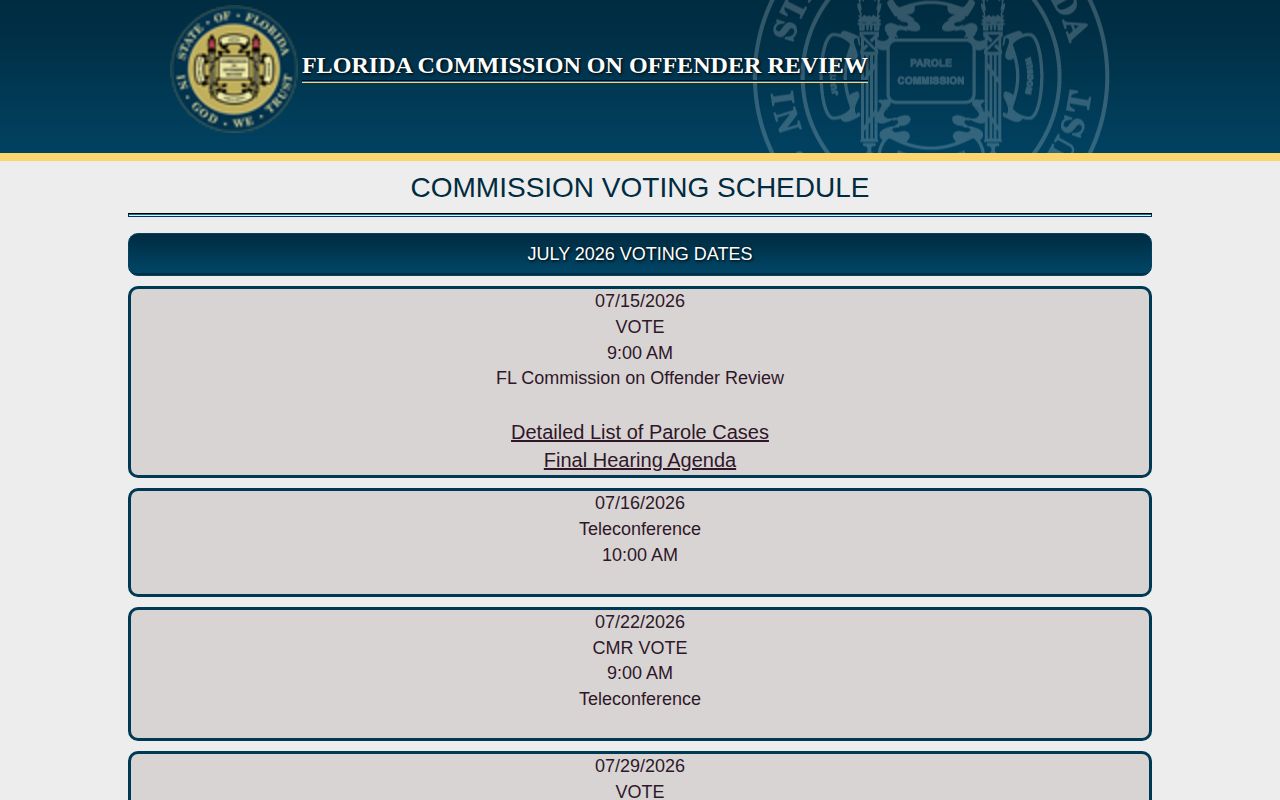
The captured schedule demonstrates calendar access, not an individual decision. Always obtain the action or order for a final outcome.
Union County Parole Eligibility Limits
Parole is limited in Florida. FCOR explains that ordinary parole was effectively abolished for many offenses committed on or after October 1, 1983, with special cohorts and older sentence structures governed by their own law. Section 947.16 supplies interview timing only for a person who is legally eligible. It should not be used to promise eligibility from sentence length alone.
For an eligible sentence, Florida Statutes §947.16 sets initial interview ranges tied to the sentence. An indeterminate term or a term of three years or less can fall within eight months. Longer terms have later intervals, and life terms have their own timing. Special mandatory-minimum structures may alter the rule. Section 947.174 addresses later interviews and permits different cycles for specified older serious cases when required findings are made.
Read the official parole eligibility statute.
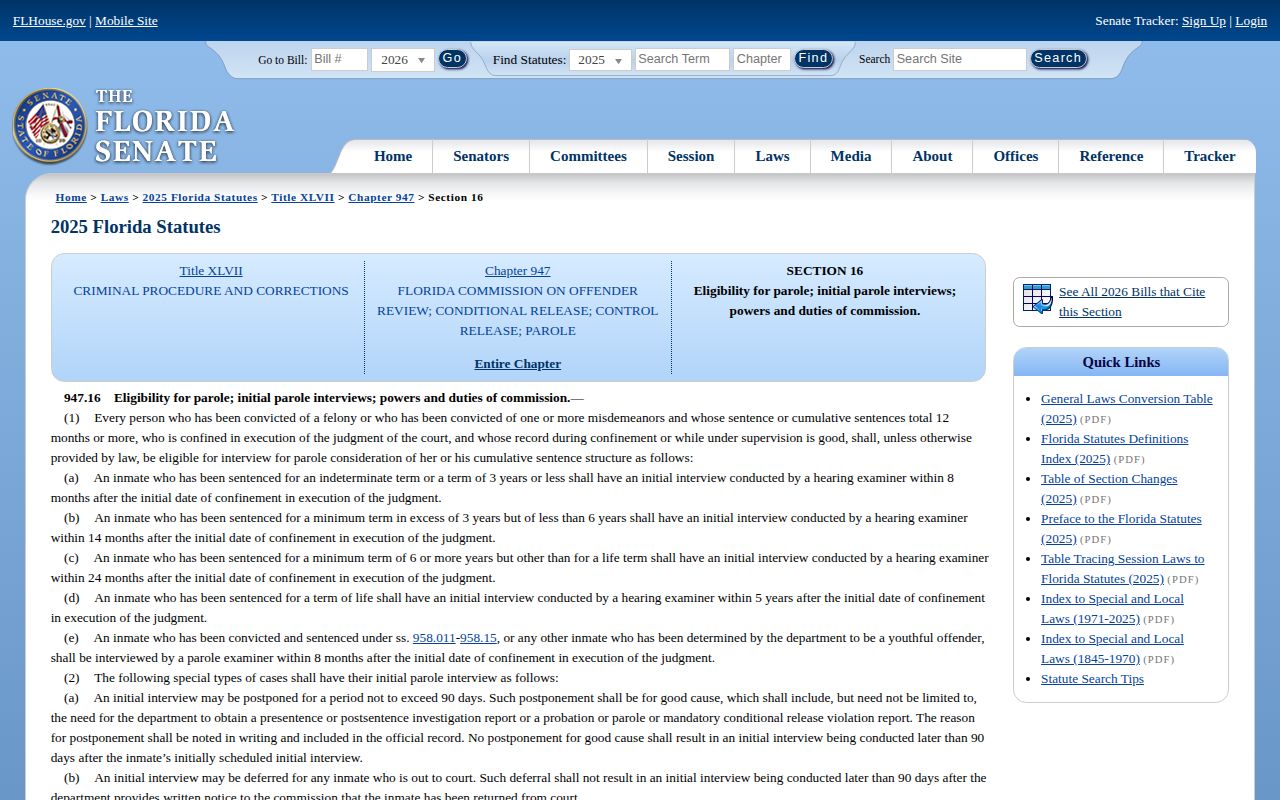
The statute is a framework. The sentence, offense date, offense category, and FCOR record determine how it applies to one person.
Conditional release is not parole. Under §947.1405, it is a separate post-prison supervision mechanism for qualifying prisoners, often tied to gain time. The displayed release type controls.
Union County Absconder Record Checks
An alleged supervision violation does not automatically equal an active warrant. An absconder is a person the supervising authority alleges has stopped complying or cannot be located. A warrant is a court or agency command authorizing arrest. A stale address, missed call, or ordinary no-result page is not enough to label someone either way.
FDC supplies a distinct absconder and fugitive search. Use its fields and compare the DC number and identity data. UCSO’s Civil/Warrants unit describes local warrant duties but does not publish a public name-search list. A local warrant must be confirmed with the issuing court or law-enforcement agency.
Conditions can include reporting, residence limits, travel approval, payment duties, treatment, or other terms set by the court or commission. The actual order controls. FCOR may review conditions or conduct revocation proceedings, and a willful, substantial violation can lead to return to prison. VINE can provide custody event alerts, but it is not a supervision-order database.
Note: Read a current official status and confirm the issuing authority before treating a wanted or absconder label as active.
Union County ID After Release
A valid identity document can matter when a released person begins reporting and corrects official records. The Union County FLHSMV location listing identifies limited driver-license service in Room 108 of the courthouse complex. That is the same complex used by sheriff records and clerk offices, although each office has a different job and its own document rules.
The location is an official starting point, not a promise that a specific credential will be issued. Check FLHSMV eligibility and document requirements before visiting. If a Union County Jail record is wrong, contact UCSO Records rather than the license office. If the error is in an FDC prison or supervision record, use FDC Central Records or the assigned supervision office. Send the correction to the office that created the record.
This local split helps avoid delay. Identity service, jail records, court files, and supervision files may be housed near one another, but they remain separate government records.
Union County Supervision Discharge
Supervision ends through a formal legal event, not simply because a person stops appearing at an office. A probation case may end through completion or a court termination order. Parole or conditional release can end under the governing commission action and sentence. A violation or revocation can interrupt that path and return the person to custody.
For a durable check, compare FDC’s current supervision status with the court docket or FCOR action that controls the term. Ask FDC for a discharge record when the public result lacks the needed detail. Florida public-record law permits inspection and copying of nonexempt records, but agencies may redact protected data and need not create a new explanation. A narrow request with the person’s name, DC number, case number, supervision type, and approximate discharge date is more likely to locate the existing record.
Keep the terms precise. Release ends confinement. Discharge ends the legal custody or supervision shown in that record. One can happen long before the other.