
Union County Three-Day Release Access
No official online release list was located as of July 14, 2026, and no separate Union County three-day view was found. UCSO does not provide a verified rolling 72-hour dashboard, archive, or public filter. The Florida Department of State county-jail directory lists Union County Jail at 50 NW 1st Street and gives 386-496-2501, yet its Union row contains no inmate-search link. That makes a records request the official document route.
A three-day inquiry should ask for existing records between precise timestamps. UCSO may maintain daily commitment and release lists, a jail-management report, individual booking records, or another export. Ask what already exists. Do not ask staff to build a new web-style list. VINE can help with a named person, especially while the Records Unit is closed, but it is not a bulk list of everyone who left the jail.
Check Union County Three-Day Releases
The start and end of the period control the result. “Last 72 hours” moves each minute, while “Friday at noon through Monday at noon” is fixed. State Eastern Time and include both endpoints. If the goal is only today’s activity, use the Released Last 24 Hours process instead.
- Write the exact three-day interval, including dates, times, and Eastern Time.
- Call UCSO at 386-496-2501 for immediate status on a named person or a known booking.
- Check Florida VINE and read the event label rather than assuming every status change is a release.
- Request any existing jail-management release report or Commitment and Release Lists that cover the interval.
- Ask that the result include release type, authority, and receiving agency where those nonexempt fields are maintained.
- Use the court file to explain the legal order, then use the jail record to confirm physical processing.
UCSO Records accepts requests by phone, in person, and by mail. The office is at 55 West Main Street, Room 102, Lake Butler, Florida 32054. Public counter hours are weekdays from 8:00 a.m. to 5:00 p.m., excluding holidays. A mailed request should include a self-addressed stamped envelope, enough postage, and payment for necessary copy costs.
Union County Three-Day Release Fields
Because no public 72-hour screen was verified, there is no official online column set to describe. A focused Union County request can seek the following nonexempt fields in an existing report. The list is designed to separate community release from continued custody and to tie each row to the right jail stay.
| Field | Why it matters |
|---|---|
| Full name and booking number | Identifies the person and custody episode |
| Booking date and time | Separates repeat admissions or nearby cases |
| Release date and time | Places the exit inside the requested three-day period |
| Release method or authority | Shows bond, court order, time served, sentence completion, or another basis |
| Charge and bond fields | Links the jail event to the pending or resolved court matter |
| Receiving agency or destination | Distinguishes return to the community from a transfer |
Not every field is guaranteed. UCSO can redact exempt material, and Chapter 119 does not require an agency to create a record that does not exist. If a field is withheld, ask for the nonexempt remainder and the statutory basis. Do not seek confidential medical, juvenile, victim, security, sealed, or expunged information.
Records staff recommend enough identifying detail to locate the right material. A case number, incident date and time, location, deputy name, or involved person can help. Ask for electronic copies when practical and request a cost estimate before extensive work begins. The sheriff links a fee schedule, so current charges should be checked when the request is made rather than assumed from an old copy.
Union County Release Records Persist
Florida’s GS2 retention schedule provides the most useful record name. Item 22 defines a Commitment and Release List as a record of people booked and released during a 24-hour period. It may contain the date, booking number, identity, charges, bond, how released, and return date. The schedule sets a minimum retention of one anniversary year after release.
A 72-hour interval can therefore be framed as three daily lists, if UCSO keeps that format, or as an existing release report covering all three days. The schedule does not prove that Union County creates a specific document or keeps it online. It does give a precise term for asking. Booking records have a separate one-anniversary-year minimum and may include release method information.
Jail docket books offer another historical route when maintained. GS2 describes them as summary prisoner records with permanent retention. Their fields and accessibility may differ from a release report, and a summary is not a substitute for the full booking record. Still, asking the custodian which retained series contains the needed date can rescue an older inquiry that falls outside a recent web window that never existed.
Note: Online visibility and agency retention are different; a record can remain requestable even when no public roster or archive exists.
Union County Weekend Release Timing
A three-day period is most useful when it crosses days that the UCSO Records Unit is closed. Jail operations and court-driven release processing can continue while the public records counter is unavailable. The broader interval also helps when the exact day is uncertain. Still, it should not be treated as an official rolling archive or as proof that each event was published on the day it occurred.
Use VINE for a named-person event, and call the jail information line when timing is urgent. Then obtain the source record after the office reopens. A VINE event may describe transfer, escape, death, or out-to-court as well as release. A court order can arrive before staff complete checks, property steps, or another agency’s hold. The physical release time belongs in the UCSO record.
For a named person whose case must be traced across sources, the Union County released inmate lookup explains when to use the clerk, FDC, BOP, or ICE instead of a county-only request.
Union County Release Status Boundaries
A release row needs context. Bond, a court-ordered release, time served, or completion of a county sentence can mean the person returned to the community. Probation or another form of supervision may still apply. A move to FDC, another county, USMS, or ICE is different. The person left Union County Jail but remained confined under another authority.
| Last known event | Correct follow-up |
|---|---|
| Community release from Union County Jail | UCSO release record, VINE event, and court disposition |
| Transfer to a Florida prison | FDC offender search by name or DC number |
| Transfer to another county | Receiving jail and both agencies’ transfer records |
| Federal or immigration transfer | BOP or ICE locator, not FDC |
| No match in a public tool | Call the source agency; absence alone proves nothing |
FDC’s own OBIS public-data page excludes county jail and county probation records. A person who served only a local Union County sentence may be absent from FDC. Conversely, a person leaving Reception and Medical Center or Union Correctional Institution must be checked through FDC because those are state institutions, not the county jail.
FDC’s released-inmate database is useful only after an actual state-prison release. A projected date in an active prison record does not show that discharge occurred. Community-supervision data may show that a person moved from confinement to supervised release, but it does not provide the Union County Jail door-out time. Keep each record within its agency scope.
Union County Feed Absence Verified
The official statewide directory supplies a useful visual check: counties with available inmate-search routes may have links, while the Union County row provides contact information without one.
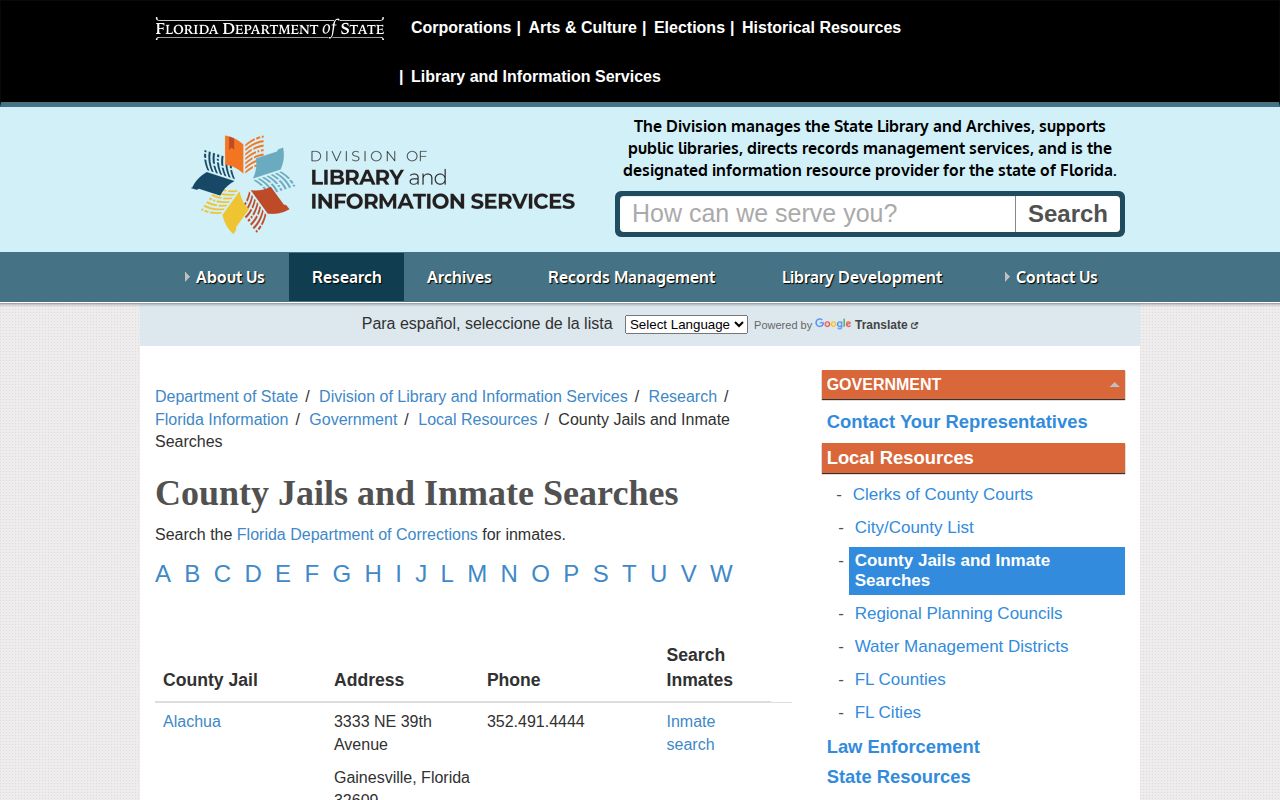
The directory supports the documented absence of an official public Union County recent-release feed as of the research date. It does not show that UCSO lacks internal release records. Use its phone information to begin the status check, then route the document request to the Records Unit.
The sheriff’s own navigation points to the County Jail, Public Record Requests, Civil and Warrants, and contact information rather than a release dashboard. Those official routes divide the inquiry by task. The jail line handles current status, the Records Unit handles existing documents, and the court file explains the case order. Keeping those roles separate avoids treating a general contact page or warrant page as a three-day release list. The exact interval should remain consistent across every contact.